
How can I tell if I have authentic Da Hong Pao Tea?
Authentic Da Hong Pao is a rock oolong grown in the Wuyi Mountains (Wuyishan, Fujian, China), and you cannot judge it by color alone. Look for a clear origin claim, lot or harvest details, roasted twisted leaves, and a seller who explains the grade. Be wary of very cheap tea sold as rare or mother-tree Da Hong Pao, because harvesting of the mother trees stopped around 2006.
Free download
Coffee, Tea and Hot Drinks Storage Chart (PDF): How long coffee beans, ground coffee, tea, cocoa and creamers last. 11 rows, each with its source.
Thank you
Your chart is ready
We use your email only for this download.Also free:
Home Bar Storage Chart (PDF)Milk and Dairy Storage Chart (PDF)Juice, Soda and Water Storage Chart (PDF)Drink Strength, Calories and Units Cheat Sheet (PDF)Want the full pack? About 10 printable sheets: a larger chart for each drink type, a “has it gone off?” checklist, date labels, a party planner and an inventory sheet.
In this article
What makes Da Hong Pao authentic?
Da Hong Pao (Big Red Robe) is an oolong from the Wuyi Mountains in Fujian, China. Real Da Hong Pao should come from that region, and the best tea is grown within the Wuyishan scenic area on rocky slopes (often called zhengyan or core rock tea). Tea grown outside the core area can still be sold as Da Hong Pao but is generally a lower tier.
Can you buy mother-tree Da Hong Pao?
No. Harvesting from the famous original mother trees was stopped around 2006 (sellers date it to 2006 or 2007), so any seller offering them as ordinary stock is making a doubtful claim. Most tea in shops is either a cultivar-based Da Hong Pao grown from cuttings or a commercial blend of Wuyi rock teas sold under the name.
What to check before buying
- Origin: Wuyishan or Wuyi Mountains named clearly, ideally with the growing area.
- Harvest and roast details: a harvest year or season and a roast level.
- Seller information: a company with a real address, brewing notes and a returns policy.
- Price: very cheap tea claiming to be rare is a warning sign. A high price alone does not prove quality either.
What does the tea look and taste like?
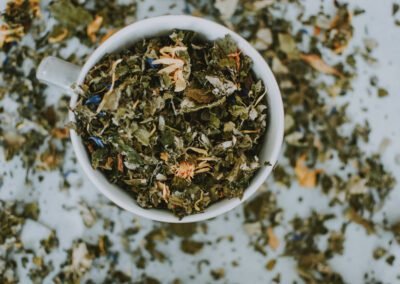
Dry leaves are tightly twisted, dark brown to green-brown, sometimes with reddish edges. Brewed tea is usually orange to amber. Aroma and flavor are roasted, often with floral or fruity notes and a mineral feel called rock charm. If it tastes only of char or cardboard after the first steep, it may be a weak or over-roasted tea. This depends on roast and grade, so these signs are guides, not proof.
How to test it
- Buy a small sample (about 10 to 25 grams) first.
- Brew with fresh water in a small pot or gaiwan, using plenty of leaf and short steeps of 15 to 20 seconds at the start.
- Good tea keeps its flavor over several infusions instead of fading after the second.
Common mistakes
- Trusting a dark red cup as proof; roasting and oxidation affect color.
- Buying a big tin before trying the tea.
- Assuming a famous name equals a premium grade.
People also ask
Is Da Hong Pao black tea or oolong?
It is an oolong, a partly oxidized tea that sits between green and black tea.
Why is real Da Hong Pao expensive?
Premium grades come from the limited Wuyi rock area and need careful roasting. Price alone does not prove quality.
Can I verify authenticity at home?
Not fully. Buy from a transparent seller, try a small sample and compare it with the seller's origin and grade claims.
About · How we verify this · Editorial policy · Corrections
What would help you most next?
One tap. Anonymous. It helps us decide what to build.
Thank you. The free charts above are yours to keep.