
How to serve and store Belgian Ale beer?
Store Belgian ales upright in a cool, dark place; a cellar at about 10 to 16 degrees C (50 to 60 degrees F) suits ales you plan to age. One serving guide suggests about 7 to 13 degrees C (45 to 55 degrees F) for Belgian ales and saisons. Pour into a tulip or chalice glass and leave the yeast sediment in the bottle.
Free download
Home Bar Storage Chart (PDF)
How long liqueurs, spirits, wine and mixers last, opened and unopened. Every line shows its source and the date we read it. Print it and keep it where you store your drinks.
- Kahlúa, Cointreau, Lillet, Patrón, Grey Goose, Jameson and more
- Says "no official statement" when a maker gives none, so you know when to check the label
Thank you
Your chart is ready
We use your email only for this download.Also free:
Milk and Dairy Storage Chart (PDF)Juice, Soda and Water Storage Chart (PDF)Coffee, Tea and Hot Drinks Storage Chart (PDF)Drink Strength, Calories and Units Cheat Sheet (PDF)Want the full pack? About 10 printable sheets: a larger chart for each drink type, a “has it gone off?” checklist, date labels, a party planner and an inventory sheet.
In this article
How should you store Belgian ale?
- Upright: many Belgian ales are bottle-conditioned, and standing the bottle upright for several weeks lets the yeast settle at the bottom. Upright storage also limits contact with oxygen in the headspace. Some traditional Belgian bottles are designed to rest on their sides, so check the maker’s advice first.
- Cool and dark: a cellar at about 10 to 16 degrees C (50 to 60 degrees F) suits beers you plan to age, including Belgian ales. Avoid temperatures above about 21 degrees C (70 degrees F).
- Steady: avoid swings between cold and warm.
What temperature should Belgian ale be served at?
Guidance differs by source and style, and we found no single authoritative figure, so treat these as starting points from one serving guide:
| Style | Serving temperature |
|---|---|
| Belgian ales and saisons | about 7 to 13 degrees C (45 to 55 degrees F) |
| Sours and lambics | about 7 to 10 degrees C (45 to 50 degrees F) |
| Strong, dark styles such as barleywine | warmer, about 13 to 16 degrees C (55 to 60 degrees F) |
Colder temperatures mute flavors, so a bottle straight from the fridge may need a few minutes before you drink it. Check the brewery’s own advice for a specific bottle.
What glass should you use?
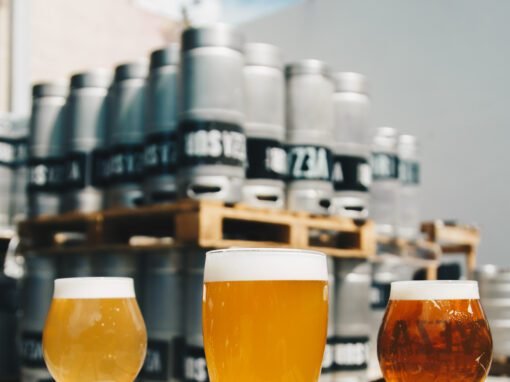
A tulip glass has a bulbous body and flared rim that concentrate aromas, and suits tripels, dubbels, quadrupels and saisons. A chalice or goblet, with a wide mouth, is the traditional glass for Belgian abbey and Trappist ales. A clean glass helps the head and aroma.
How do you pour a bottle-conditioned Belgian ale?
- Keep the bottle upright, ideally for a day or more beforehand.
- Pour slowly and steadily in one go, at an angle first.
- Stop before the last bit, where the yeast sediment sits, unless you like it cloudy. Sediment is harmless.
How long does Belgian ale keep?
Refermented beers keep developing and can last several years without a problem, according to one brewer; the best time to drink one is a matter of taste. Lighter, hoppy styles are best fresh. Check the best-before date on the label.
People also ask
Should Belgian beer be stored upright?
Usually yes, so the yeast settles and oxygen contact is limited. Some traditional Belgian bottles are designed to rest on their sides, so check the maker's advice.
What temperature should Belgian ale be served at?
One serving guide gives about 7 to 13 degrees C (45 to 55 degrees F) for Belgian ales and saisons; check the brewery's advice for a specific bottle.
What glass is best for Belgian ale?
A tulip glass for many styles such as tripels, dubbels and saisons, or a chalice for abbey and Trappist ales.
Sources
About · How we verify this · Editorial policy · Corrections
What would help you most next?
One tap. Anonymous. It helps us decide what to build.
Thank you. The free charts above are yours to keep.